
ROLE: LEAD DESIGNER
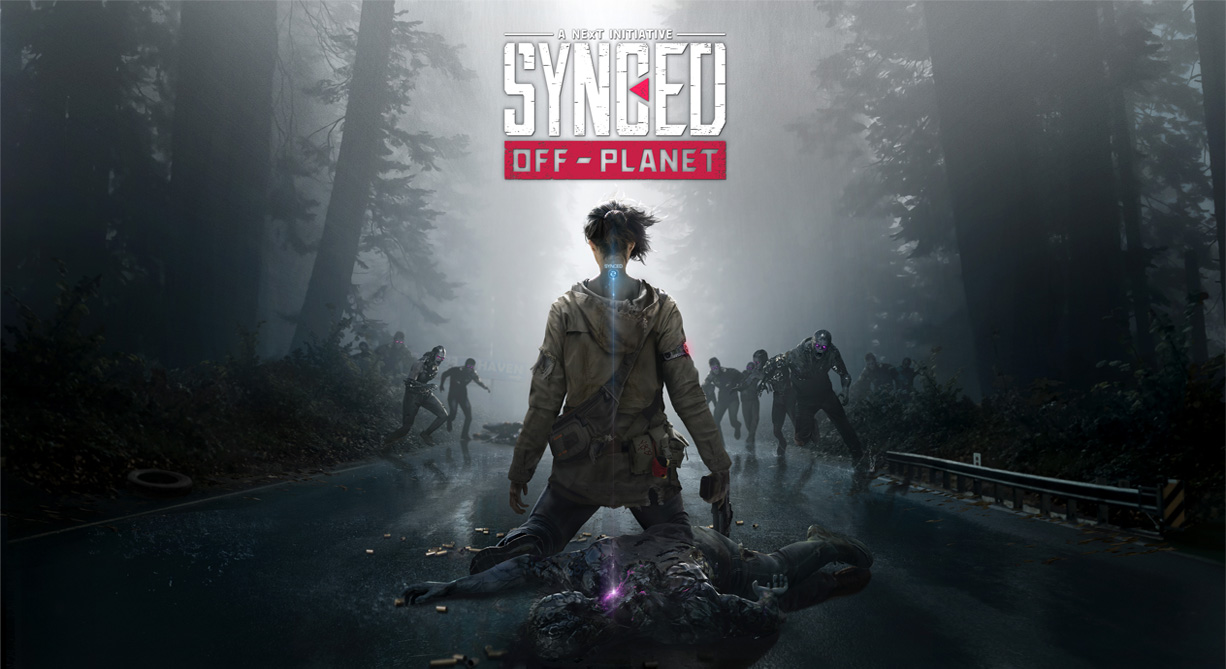
SYNCED: OFF-Planet is a free-to-play PvPvE experience with up to 50 players and 1000 corrupted human cyborgs, called Nanos (AI). The game combines survival, crafting and base-building elements, where players have to rescue more Survivors to join their team, while crafting gear and equipment to increase their chances to catch one of the shuttles leaving Earth, before other players do.
As a Lead Designer, I was tasked to help our team develop Haven, an interactive base-building space that functions as the game's "main menu" and HUB, where players can gather materials from combat, to unlock and upgrade their different sectors, leading to more unique gameplay loops. Once Haven was mainly completed, we were also tasked to design a new PvE Game Mode from the ground-up, where it consisted of endless and procedural PvE content targeted at player's that wanted a break from other players, and as a mean to earn a variety of unique loot.
Other responsibilities also included representing our Game Director's main vision throughout the project and the other departments, leading a team of Designers, conducting 1-2-1s, reviewing and giving feedback to their work and, finally, being the Design point of contact with our external partners in China, at NExT Studios.
CLIENT
Tencent
NExT Studios
DATE
July '19 - May '20
TOOLS
Unreal Editor, Visio, Photoshop, Confluence, PowerPoint, Excel
RESPONSIBILITIES

Leadership
In-house & Co-Dev
Leading and Mentoring multi-disciplinary team of Designers in-house, while being the main point of contact with the stakeholders from NExT and Tencent.

Progression Systems
Haven
Responsible for designing Haven's Base Building Progression Loops, including Economy, Population Design, Match Flow and Missions, from Creative Brief, to Paper Design and Implementation.

PvE Mode
Rescue Survivors
Led the team responsible for creating an endless and procedural PvE content targeted at player's that wanted a break from other players, and as a mean to earn a variety of unique loot that tied back to the main gameplay in Haven.
PROJECT OVERVIEW
Synced: OFF-Planet is probably NExT's most ambitious project to date. This is their first AA free-to-play game that not only have targeted their familiar eastern market, but also their first go on the western. For that reason, and also because of Studio Gobo's growing reputation as a co-development studio, NExT and Tencent have decided to partner up with us, to help them reaching their goal.
We were introduced to this great and passionate team from NExT and Tencent, and quickly brought up-to-date with Clark Jiayang Yang's (NExT's Game Director) vision of the game, where he presented the game's core triangle structure: Catch the Ark-Shuttle (PvPvE Loop); Rescue Survivors (PvE Loop); and Haven (Base Building Loop). Very soon we also learnt how important the narrative and world building of the game was for Clark, and that this should be reflected across every single feature we were to create.
The Mandate assigned to us was quite clear from the beginning. We have being tasked to create Haven, an interactive space where players would always be loaded into every time they started their game, and where they could get access to the different game modes and options. In a way, Haven's main purpose was always to be an innovative menu screen, but that would also introduce its own gameplay loops and progression related systems.
We agreed on an initial timeline where our team would bring Haven to a fully playable space by the end of the year - 6 months of work - for then entirely swift our team's effort towards creating a completely new PvE Game Mode that would bring another layer of replayability to the game, with procedural and endless content. Meaning that from the game's core triangle structure presented for us from the beginning, we were responsible for two of them.
HAVEN - BASE BUILDING LOOP
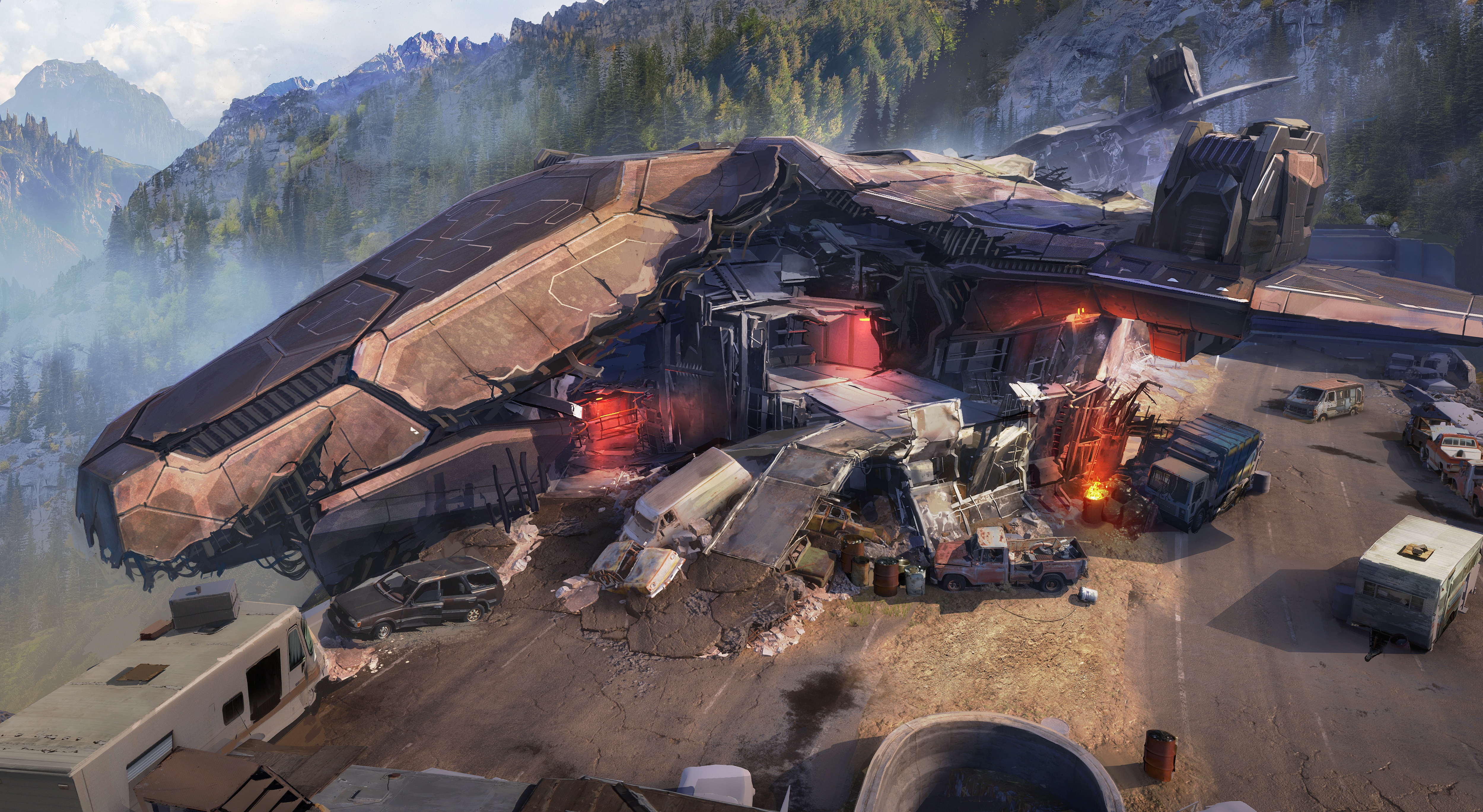
From the game's lore point of view, Haven was the result of a rushed attempt to send a special Cargo Ship to the Ark Station. When leaving Earth, this Ship had trouble, losing power and colliding in a Free-way, forming what it is now a Crash Site. As time passes, some Survivors get to find this crash site, gathering and building Haven upon the devastation, to renew their hope.
We had a very clear direction that Haven should never feel like a destination, or a safe enough space to live in, but instead, this should be player's rest stop to recover and ready themselves for the eventual escape from Earth (PvPvE Game Mode's Loop).
Having a well advanced ship as the setting for Haven, also helped justifying where all of this technology could come from, once player started engaging with the different systems and upgrading the sectors to its next Tiers. The plan worked quite well, and gave us enough opportunity to explore some other narrative elements for Missions, and the overal arch for the story.
We have set to ourselves three pillars / intentions that would remain strong throughout the development of Haven:
- Empowerment - A growing sense of hope and chance of escape.
- Immersion - Believable, safe but not impenetrable, temporary and improvised.
- Identity - A visual record of your choices and experiences.
HAVEN'S PROGRESSION AND BASE BUILDING
We were given a very high level requirement list about how NExT expected the progression in Haven to happen, how big this level should be, and which sectors should exist in Haven. From this list - and from the initial direction received from our Game Director at Studio Gobo - I have put together an initial Creative Brief for Haven's overall progression, considering its individual sectors' gameplay, Resources and Economy Design. This Brief has been shared with NExT, that approved and gave us the first thumbs up to start designing it in more details and start implementing it in Unreal.
We designed two types of Progression that would always run in parallel: Haven's Level (Passive Progression), and Sector's Specific Upgrades (Active Progression).
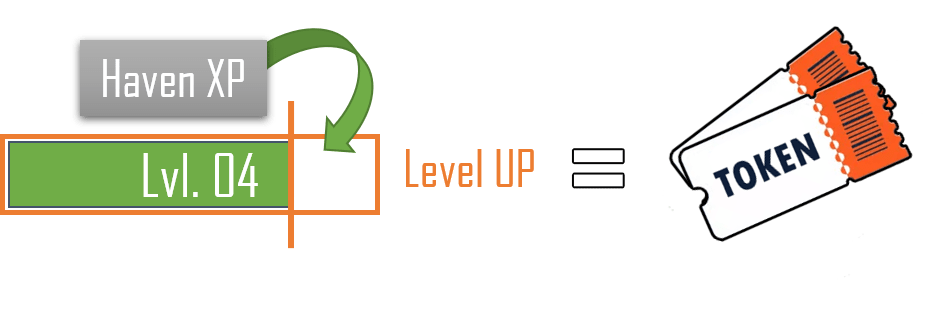
Haven's Level - As player progresses on the game's PvPvE and PvE Mode, they earn Haven XP. Between matches, this XP is passively added towards our Haven Level (meter), and once levelled up, the player is rewarded with a Haven Token (which later were named Cores). The availability of specific Sectors were gated by this level, which helped us pacing the content and avoided overwhelming players when teaching what each new sector provides to the game. Finally, this Haven Level also served as a way to indicate player's overall progression in the game. Haven's Level was capped differently every season, so we could have more control over stretching the content as long as we needed to.
Sector's Specific Progression - It was decided that Haven would have multiple sectors, where most of those would provide an specific gameplay purpose and could be actively upgraded from Tiers one to five, by player. Once a Sector has become available (based on Haven's Level), player was able to consume Haven Tokens to upgrade a Sector from one Tier to another. As this currency [Haven Token] was the same used for any of the Sectors, player had the freedom to chose which Sector to upgrade next, creating their own paths based on their playstyle and on what gameplay benefits this Sector would offer to player. Giving this freedom to player was very important for us, because it not only affected player's gameplay experience, but also generated conversation and comparison between yours, and your friend's Haven.
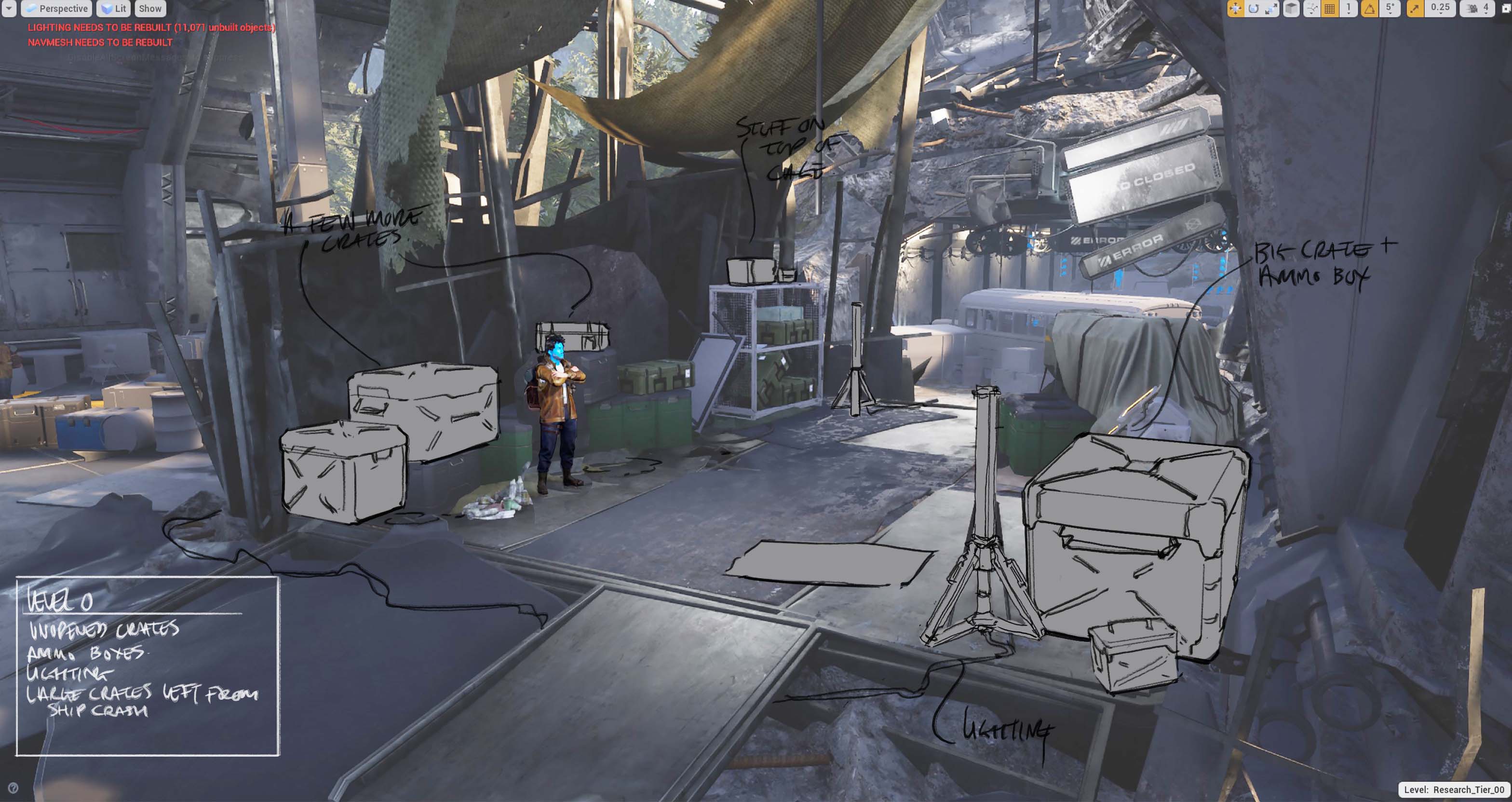
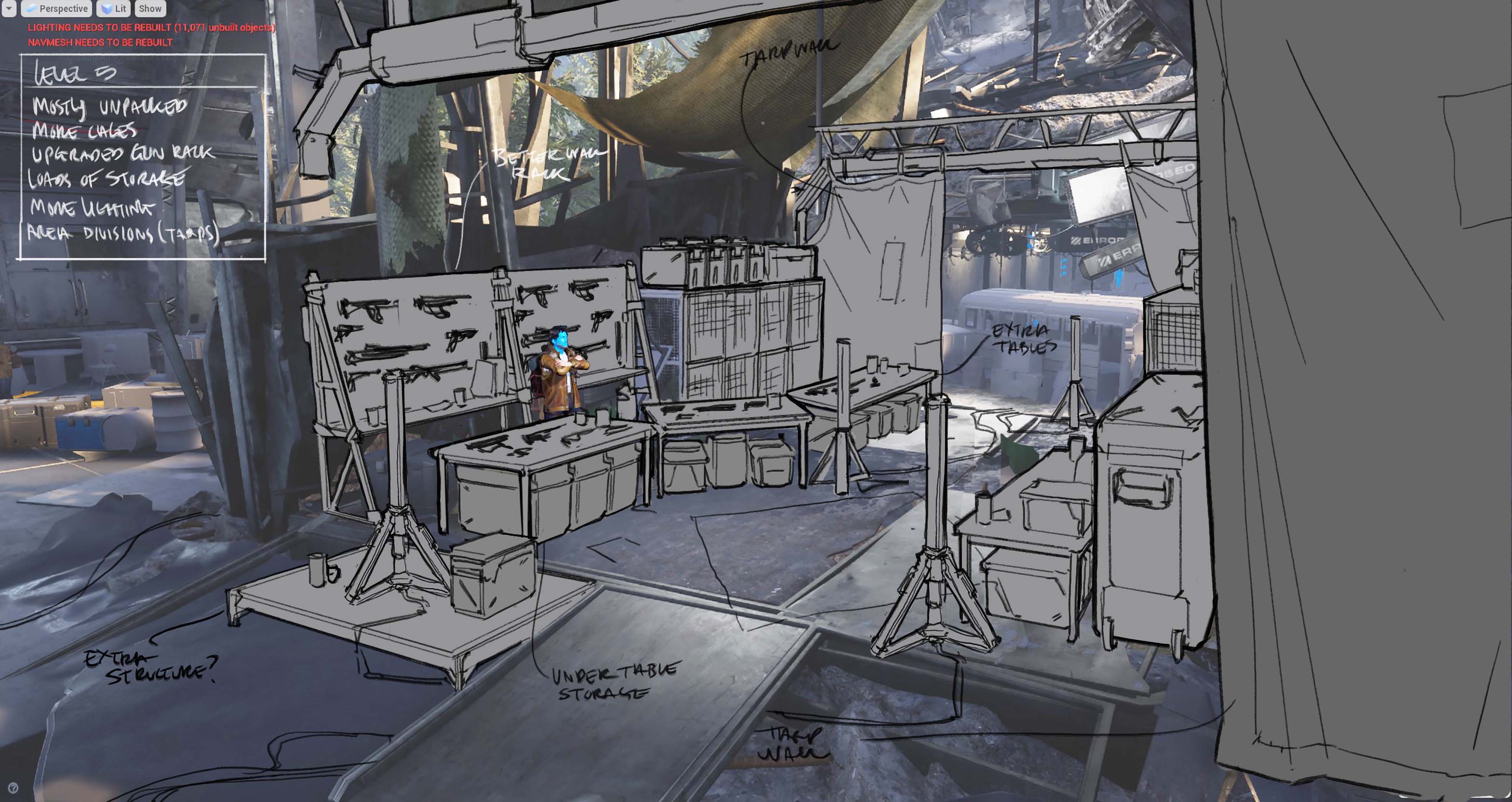
Haven was composed by a Plaza, a Situation Room, a Radio Tower, a Basic Shooting Range, a Medic Bay, a Living Quarters, a Research Center, and an Arsenal Testing Field, where the last four sectors were upgradable. Upgrading a sector's Tier not only unlocks more gameplay functions and buffs, but also visually upgrades the environment, when reaching specific milestones.
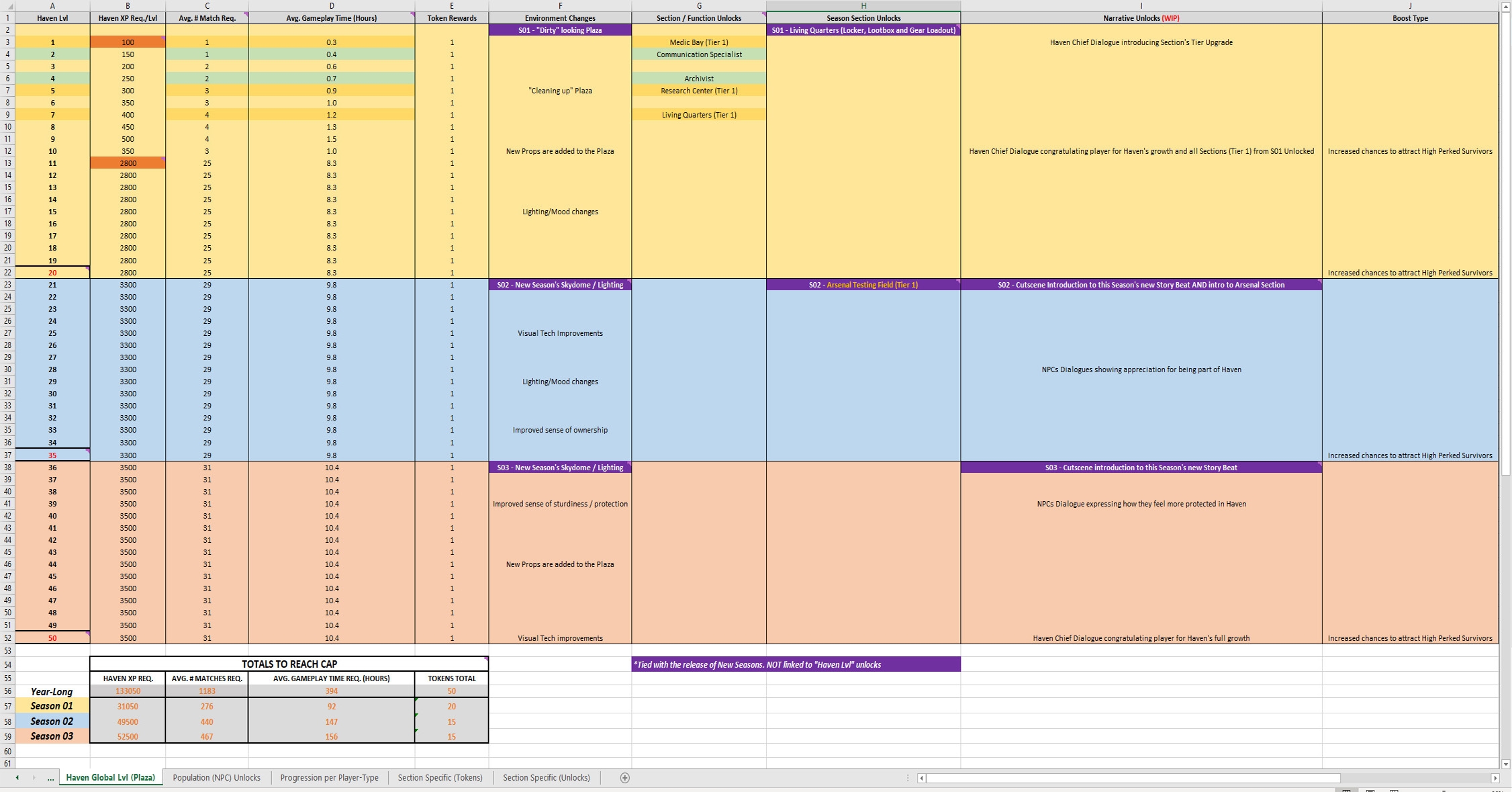
ECONOMY DESIGN - BALANCING A YEAR-LONG PROGRESSION
Because of Synced's ever growing online nature, we knew from start that the release of the game wouldn't mean the "end" of it. Quite the contrary, that's when the team would have to create even more and more content, to keep the players interest and commitiment to it.
When looking at Haven, we had to design a Year-Long Progression that was split into four different seasons of three months each (changed into three seasons, later in development). This progression would have to take into account the number of Haven Tokens the player would be able to obtain per season, how many NPCs, missions and story beats we would introduce and which sort of sectors and gameplay functions would be available. We had to make sure that even if a player has decided to spend hundreds and hundreds of hours during the first season of the game, they wouldn't be able to burn through all the content.
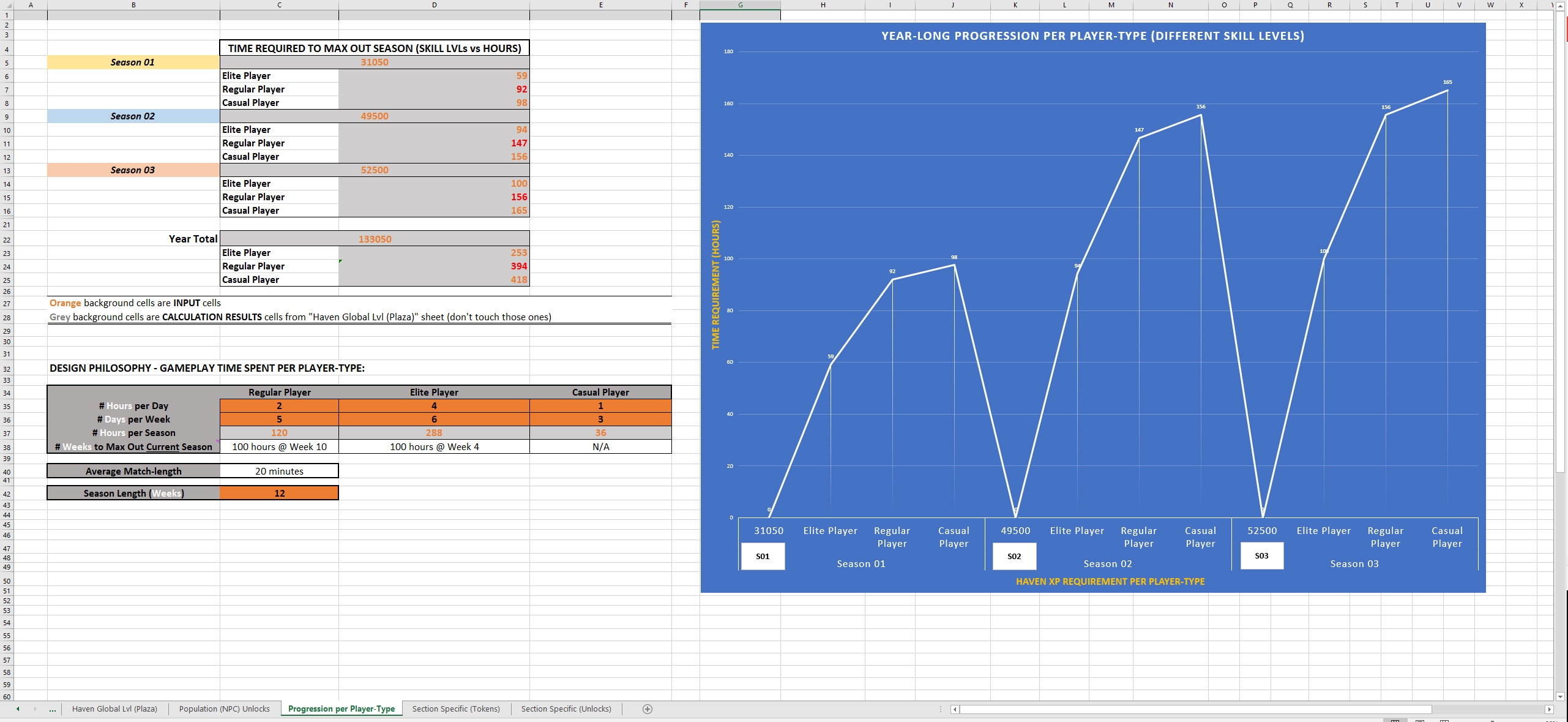
To define the pacing of this progression, we had to go through an initial exercise of studying and designing a Progression per Player-Type graph, where we evaluate the different types of player that ranged from Casual to Elite. Considering the maximum possible number of winning teams per match, versus the total number of teams in the same match, we came down to an average winning ratio of 12.50%, for the average type of player. This helped us deciding how much XP a player should earn when winning - or losing a match - based on how many matches (and minutes) would be required from an average type of player to level up in Haven.
These numbers would quickly change if we only have considered the "Elite" type of player, easily found in the Chinese Market, where they could potentially spend 300 hours of gameplay time in a single season. Because this game was also aimed for the Western Market, we've decided to keep the focus on the average type of player, that is placed in between the Casual and the Elite. This reduced our risks and brought us down to an average of 100 hours of gameplay time, per season.
With this aim in mind, we were able to define the maximum Haven Level Cap behind each Season, which directly led to how many Haven Tokens (and Sector Upgrades) a player would be able to complete in the first three months of the game.
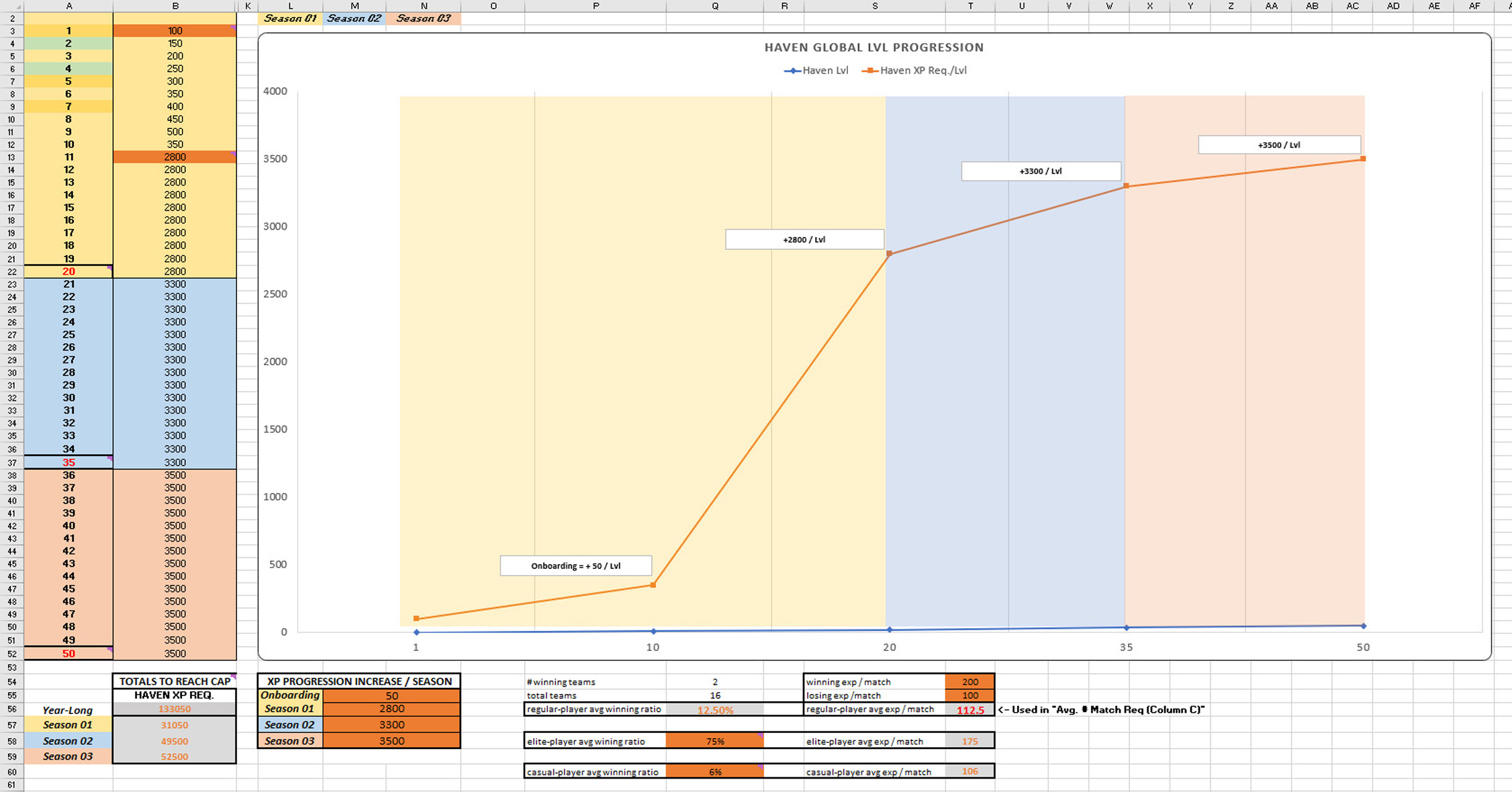
Because the introduction of the first tier of the different Haven Sectors were gated behind player's Haven Level, and each Sector would introduce a vital gameplay element for the "main" PvPvE Game Loop, we had to make sure to treat the pacing for the Onboarding of the game, a little bit differently than the rest.
During Onboarding (Haven Lvl 1-10), the XP required to level up was drastically lowered down, so we could introduce the basic functions of Haven within the first 9 hours of the game. After Onboarding, XP requirement would hugely increase and maintain linear between levels within the same Season, with each new Season raising the amount needed.
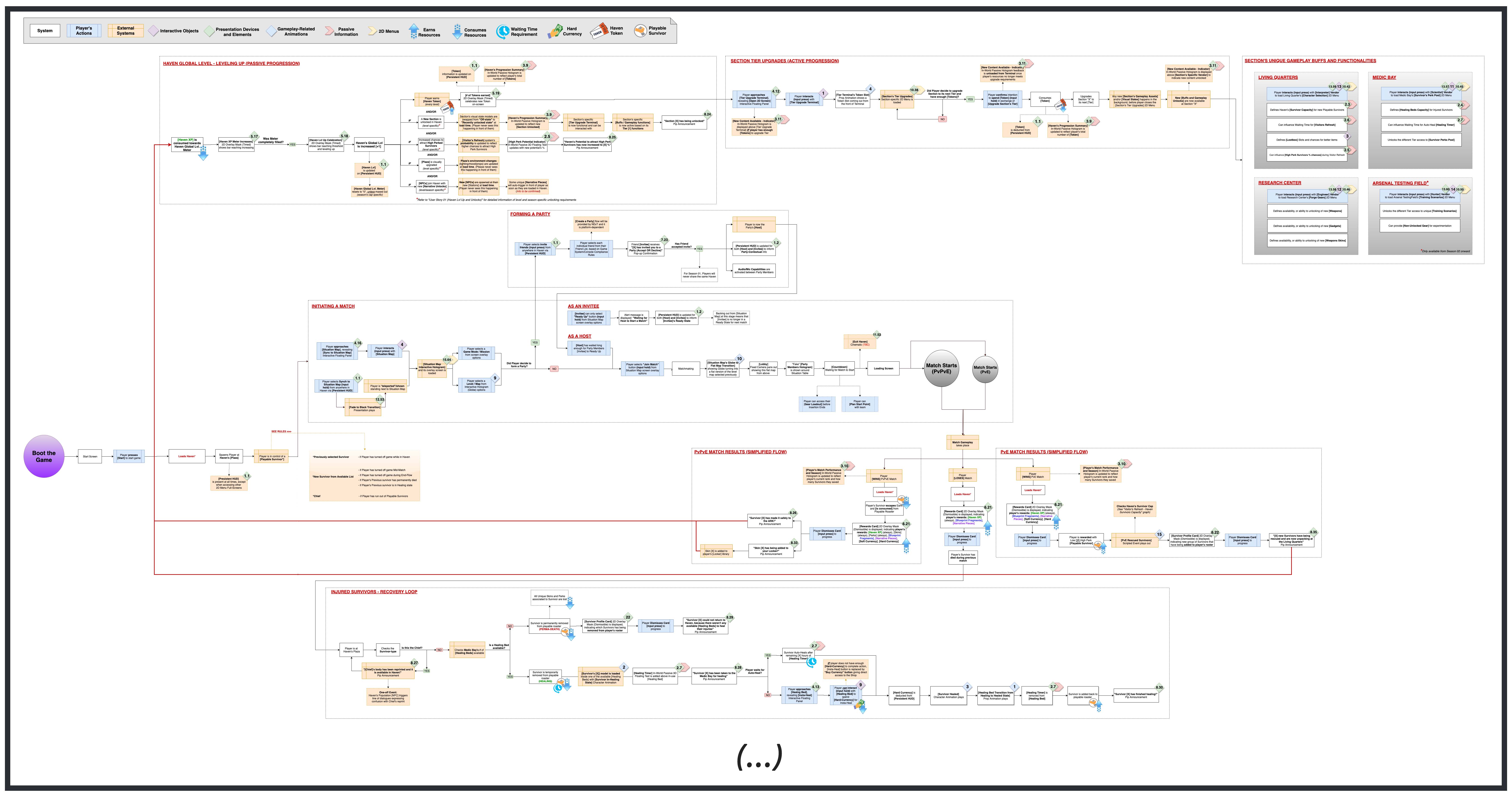
TRANSLATING DESIGN REQUIREMENTS INTO USER STORIES
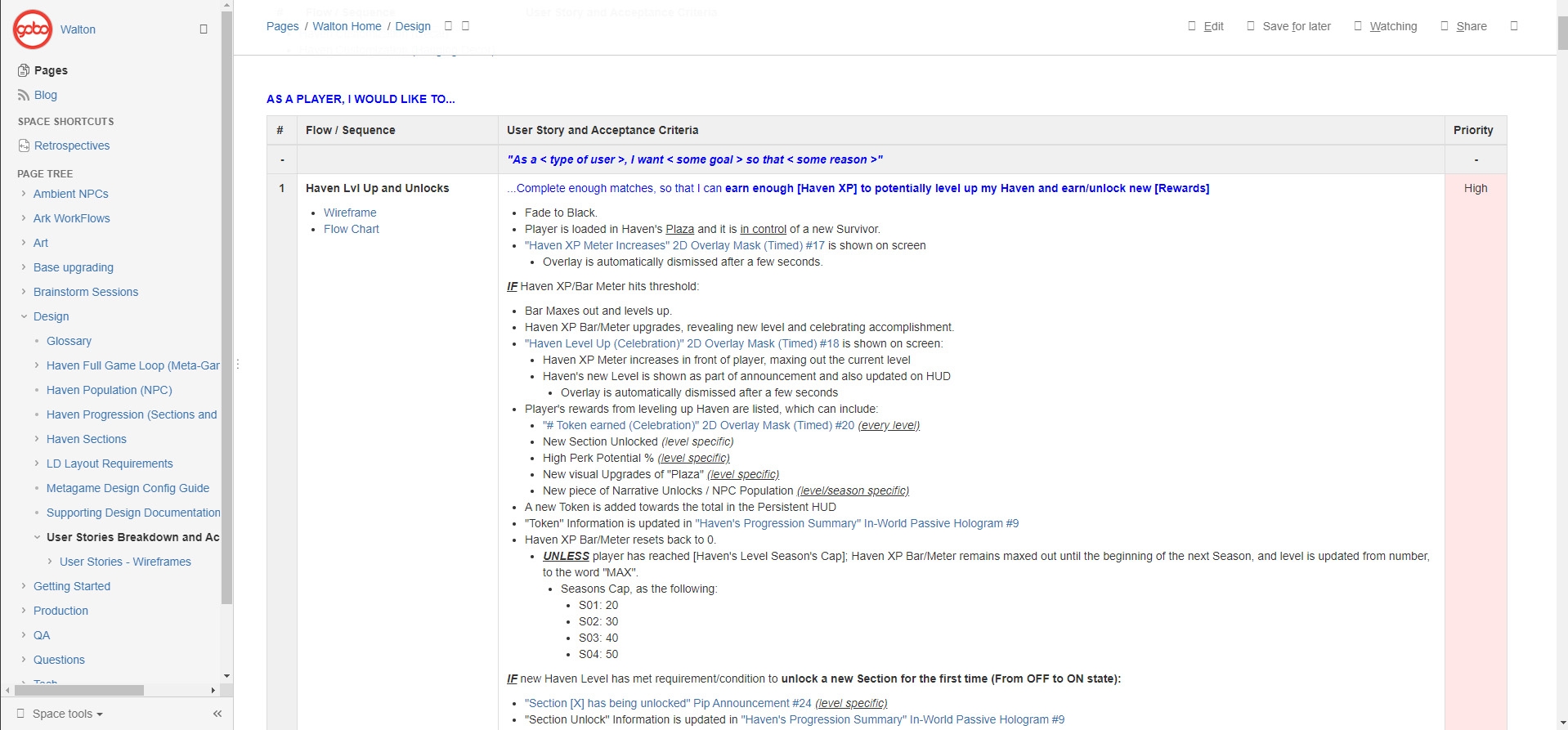
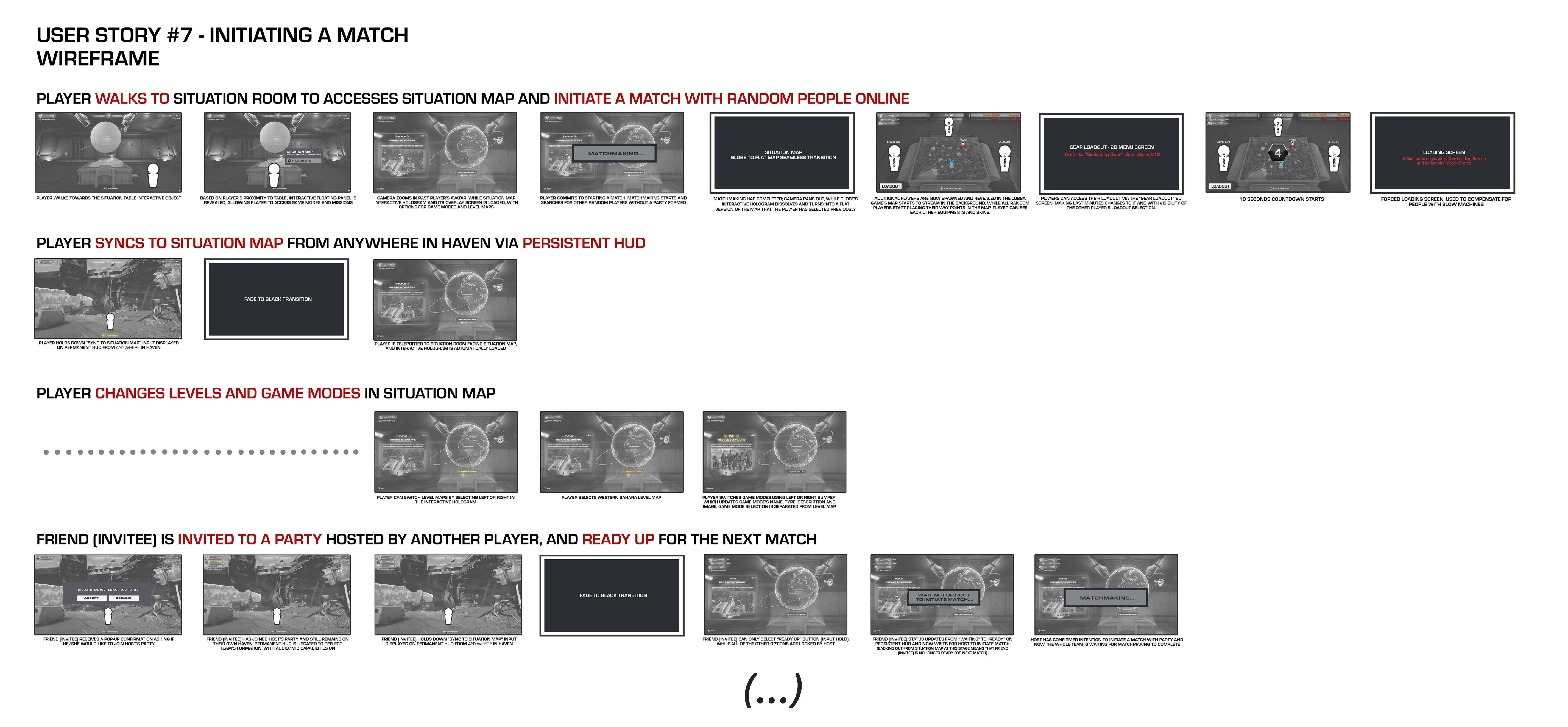
Once a big chunk of the design had being signed-off, we started evaluating what could be the best method to translate these requirements into a comprehensive format. That's when the User Stories and Flow Charts sounded like the best way to do this. I broke down each individual feature for Haven and converted them into User Stories, following the format: "As a <type of user>, I want to <some goal> so that <some reason>".
This turned out to be a task that took a lot of my time, but that felt vital for the rest of the project. The plan was also to include Acceptance Criterias for each individual User Story, so we could define the boundaries of a story, use it to generate tasks for all departments and also as a way to confirm when a story had been completed and working as intended, once implemented.
Each User Story was also organized per Order of Priority and accompanied by its own detailed Wireframe and Flow Chart. When refered to within a specific story, I would also point the team towards more detailed lists for individual items that belonged to categories such as Interactive Objects, Presentation Devices, 2D Menus and Gameplay-Related Animations. These were also refered back to the Flow Charts itself. At the end of the day, this turned out to be a go-to "bible" that would cover all the information and edge cases, using different methods that would work best for each department.
During development, the team and myself would always go back to these User Stories to confirm our work. The QA team had also relied on these, to generate their own Test Plans.
POPULATION DESIGN - FROM DEFINING NARRATIVE BEATS TO ANIMATION REQUIREMENTS
One of Haven's most exciting features had everything to do with its Population.
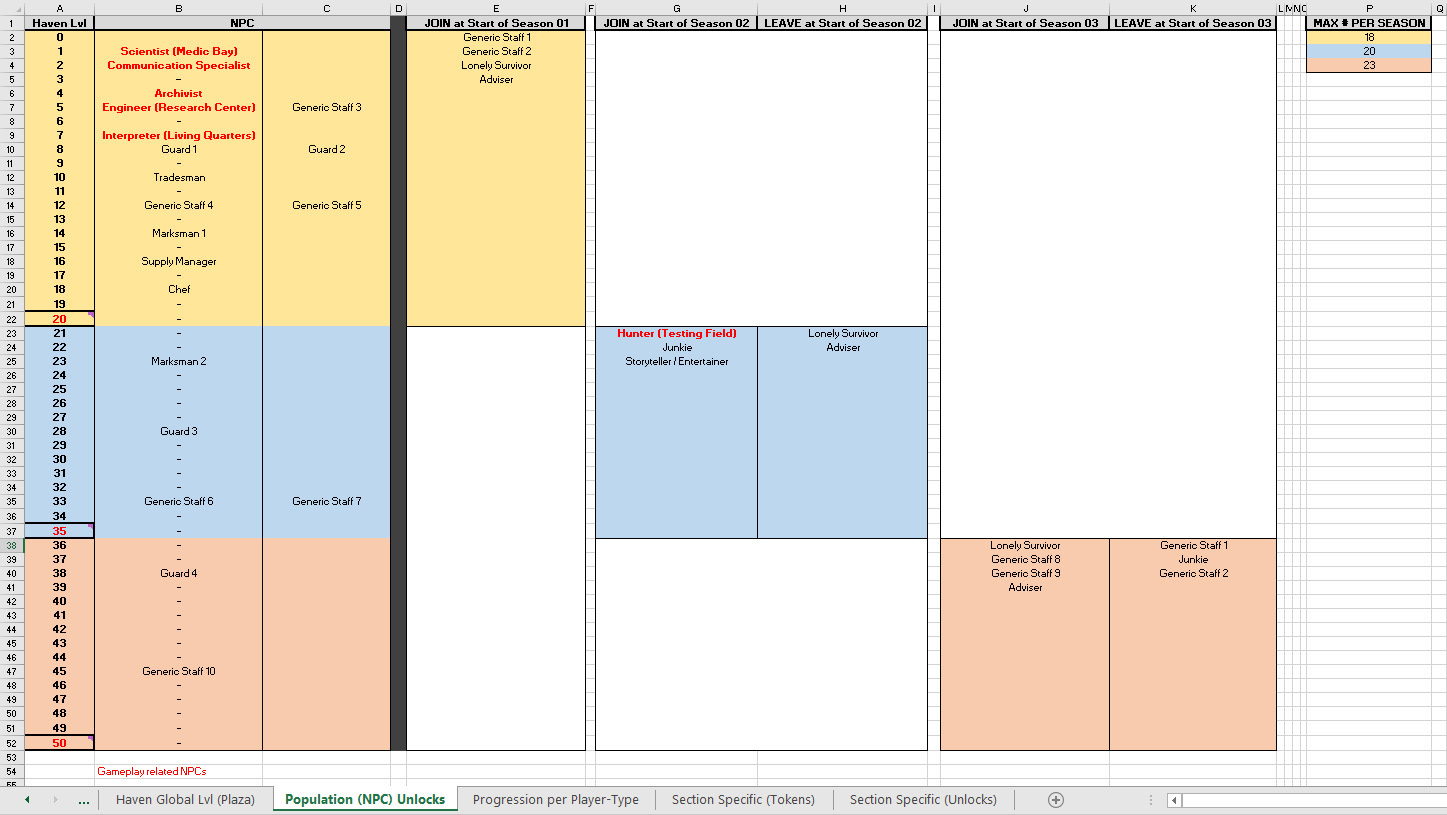
To convey a real sense of living space, we had designed three categories of population: Vendors, Regular NPC and Archetypes.
- Vendors - NPCs that joins Haven with the intent to unlock a new "shop" with its own features.
- Archetypes - NPCs that eventually make themselves available as a "Survivor" that player can synch to, and control as their new avatar.
- Regular NPC - NPCs that add more depth to the game's narrative and overall Haven population.
As player progressed through the game and increased their Haven Level, new characters would join Haven, unlocking new interactions. Some of these conditions were also tied to different Seasons of the game, creating a sense that there was always something new just around the corner, and a reason for player to continue playing.
Characters would also sometimes leave between Seasons, which created another sense of urgency if player wanted to get the most out of each interaction or what a character had to offer.
A big part of making this feature work was dependent on our understanding of the tech constraints associated to it, especially when it comes to performance. To find a middle ground that could illustrate well our narrative intention in Haven, while also being in pair to our competition, we went through many Competitive Products Analysis with bigf AAA games out there, to understand how they managed to handle their budget, and to get a better idea on how many NPCs felt "convincing", depending on each map size.
Finally, once all groups of characters were signed-off and functioning as intended, another part of my work was to design how each of them should behave, so they could feel as convincing and livable beings. Part of my job was to learn from the animation team what were our limitations, and come up with a list of "Population Stations", where I would describe what was that character's function on our world, what they should represent, how they should "act" in the level, and all of their "schedule".
THE GAMESCOM RIPPLE EFFECT
Another big moment during development was when the game was first presented during Gamescom 2019. Even though the public had a curious reaction towards the game, we also identified some areas for improvement. The key points that came from it was that the product didn't feel much different than other products of similar genres out there. And that the world building and art direction didn't feel quite unique.
From this data, the game had to go through some big changes that would also affect how we presented Haven, but also other areas of the gameplay. From there on, the goal was to ensure that every single game mechanic had a direct visual - and contextual link - to synching and commanding Nanos - which were our key differentiation here.
Alongisde that change, Haven - as a physical space - also had to adapt and change to follow more of that technological approach from an environment art perspective. The way we started to visualize and communicate information in that physical space also had to adapt, bringing it more in line with the futuristic approach.
Finally, another big change was on the Progression Plans for the first year's approach to the game's seasons, where we reduced it to 3 Seasons, instead of the originally planned 4, directly affecting our economy, especially when it came to the game's Tokens and Haven's Population.
Overall, as disruptive as these changes were to the project, it also helped us shaping the game's universe in a more unique and interesting way!
PVE MODE - ENDLESS AND PROCEDURAL
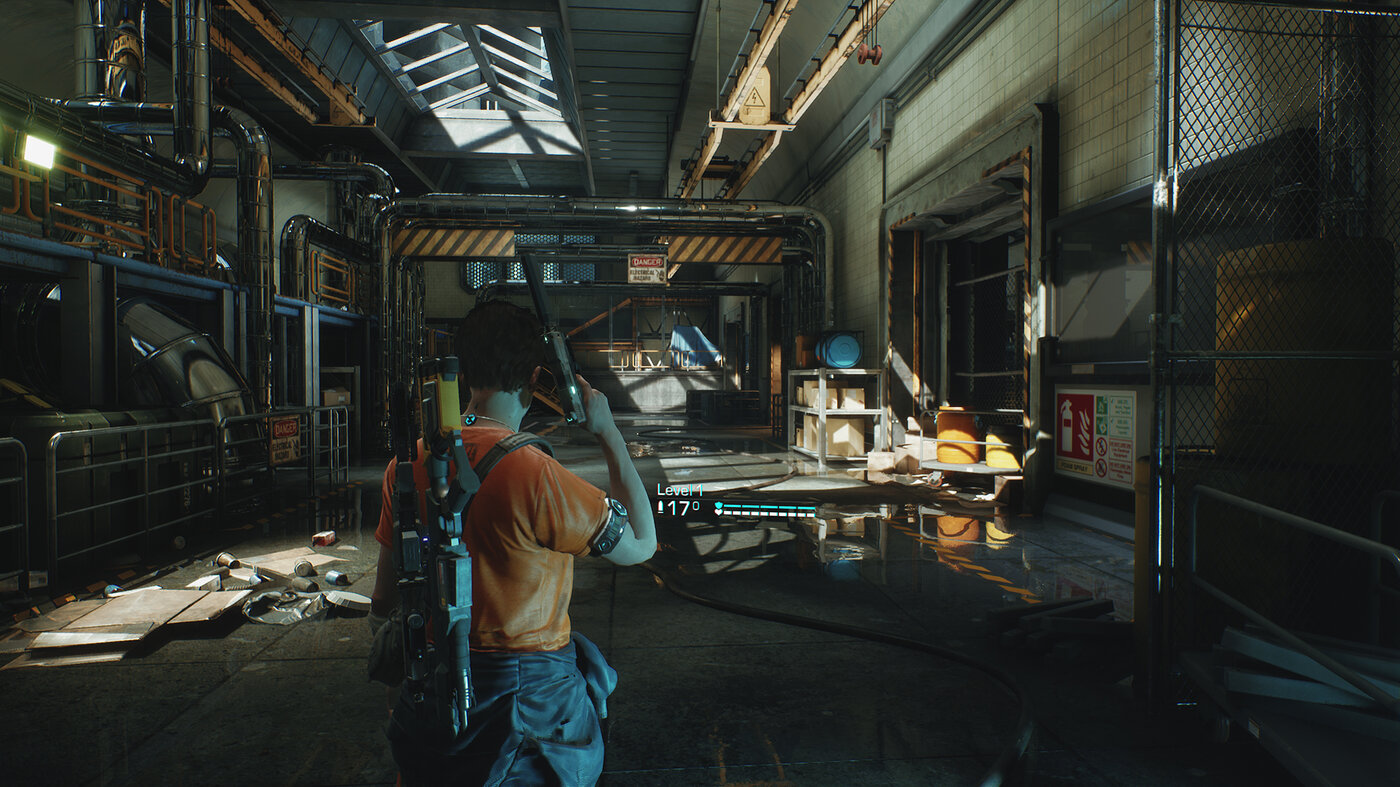
As the development of Haven was coming to an end, we had a change of focus in the design team, where a new Mandate was starting to consolidate: we were now tasked to create a brand new PvE mode that would perfectly fit with the game's core triangle and create another means of replayability.
This was an endless and procedural PvE content targeted at player's that wanted a break from other players, and as a mean to earn a variety of unique loot. The goal was to increase the number and quality of rewards that player could earn, as players decide to move on to the next stage, but with the risk of losing most of it if they failed on the next level. This created an exciting and challenging loop that really tested players skills.
Rewards acquired from this mode was brought back to Haven, where player could upgrade even further by engaging in our other Base Building Loops, to then bring it with them to the main PvPvE game mode.
CLIENT RELATIONSHIP - AN EXTENSION OF THE SAME TEAM
Working on a project of this scale was more than just a professional milestone; it was an exciting cross-border collaboration. We didn't just operate as a co-dev studio; we truly felt like a seamless extension of the core team. This sense of unity was anchored by the immense respect we received from their directors, which fostered an environment where our influence extended far beyond our assigned tasks. We weren't just designing our own features - we were actively shaping theirs through hours of deep conversation and an open, honest feedback loop that elevated the entire product.
However, that level of integration didn't come without significant hurdles. Navigating the logistical maze of working with the team in China presented a steep learning curve. From the very first round of design documents, it became clear that the language barrier would be our most persistent challenge throughout development. When you layer that on top of the technical friction of regional communication software and the grueling reality of a massive time difference, every milestone reached felt like a hard-won victory.
Ultimately, these challenges were what made the success of the project so rewarding. The experience pushed us to refine how we communicate design intent and how we manage global workflows. Looking back, we walked away not just with a great project in our portfolio, but with a wealth of knowledge that has fundamentally changed how we approach game design on a global stage.
OTHER PORTFOLIO PIECES
AAA ACTION / ADVENTURE RPGPrincipal Systems Designer / Feature Lead
HOGWARTS LEGACYLead Designer
SYNCED: OFF-PLANETLead Designer
FOR HONORLead Designer

DISNEY INFINITY: MOANASenior Game & Level Designer
DISNEY INFINITY: STAR WARSGame & Level Designer
KNIGHTS AND DRAGONSGame Designer & Live Ops

FIFA 14: ULTIMATE TEAMQuality Analyst & Live Ops